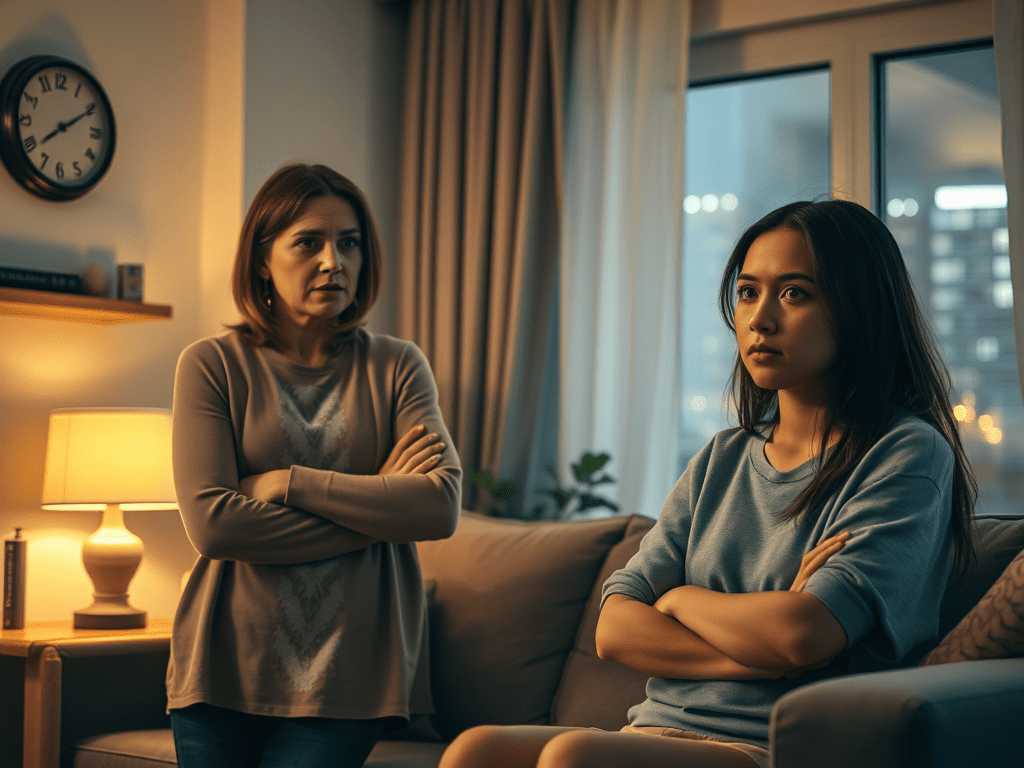
The neon-lit skyline of Metropolis glowed against the darkening sky as Lilly Bernard paced anxiously in her living room. The events of the past few weeks had taken their toll, and the weight of her concerns for Izabella’s future pressed heavily upon her shoulders. She glanced at the clock, noting that her daughter was late returning from school—again.
When the front door finally creaked open, Lilly rushed to greet Izabella. “Where have you been? I’ve been worried sick!”
Izabella’s shoulders slumped as she dropped her backpack on the floor. “I was working on a group project, Mom. I told you about it yesterday.”
Lilly’s brow furrowed. “Another project? What about your individual assignments? Have you been keeping up with those?”
“I’m trying, Mom,” Izabella replied, her voice barely above a whisper. “It’s just… different now.”
Lilly’s heart clenched at the defeat in her daughter’s tone. She reached out to smooth Izabella’s hair, but the girl flinched away. “Sweetheart, I know it’s challenging, but you’ve always been a top student. You just need to apply yourself—”
“Apply myself?” Izabella’s voice cracked as she spun to face her mother. “Is that all you think this is about? I’m trying so hard, Mom! But nothing I do seems good enough anymore!”
The sudden outburst caught Lilly off guard. She watched, stunned, as tears welled up in Izabella’s eyes.
“Every day, it’s ‘How was your project?’ or ‘Did you contribute enough to the team?’ But you never ask if I’m okay, if I’m happy!” Izabella’s words tumbled out in a rush. “Do you even care about anything other than my grades?”
Lilly felt as if she’d been slapped. “Of course I care! Everything I do is for you, to ensure you have the best future possible.”
“But what if this isn’t the future I want?” Izabella countered, her voice trembling. “What if I’m not cut out for this constant pressure?”
The silence that followed was deafening. Lilly stared at her daughter, truly seeing her for the first time in weeks. The dark circles under Izabella’s eyes, the slump of her shoulders—how had she missed the signs?
“Izabella, I—” Lilly began, but her daughter had already turned away, retreating to her room with a soft click of the door.
Across town, Kimberly Howell was experiencing a different kind of evening with her daughter, Elise. They sat at the kitchen table, surrounded by colorful sketches and diagrams.
“And this part here,” Elise explained, pointing to a intricate design, “is a vertical garden that can help purify the air in urban areas.”
Kimberly beamed with pride. “That’s incredible, honey! Your team’s project on sustainable urban development is really coming together.”
Elise’s eyes sparkled with excitement. “Thanks, Mom. It feels amazing to work on something that could make a real difference.”
As they continued to discuss the project, Kimberly’s phone buzzed with a message from Lilly: “Can we talk? It’s about the girls.”
Kimberly’s smile faded slightly. She excused herself and stepped into the living room to call Lilly back.
“Lilly? Is everything okay?” Kimberly asked, concern evident in her voice.
“I don’t know, Kim,” Lilly replied, her voice thick with emotion. “Izabella and I just had a huge fight. She says I’m putting too much pressure on her, that I don’t care about her happiness.”
Kimberly sighed, choosing her words carefully. “Lilly, I know you want what’s best for Izabella, but maybe it’s time to consider that your expectations might be too rigid for this new system.”
“But how will she succeed if she doesn’t push herself?” Lilly countered.
“Success isn’t just about grades anymore,” Kimberly explained gently. “The world is changing, and our kids need different skills to thrive. Elise is flourishing because she’s allowed to explore her creativity and work collaboratively.”
Lilly fell silent for a moment before responding. “I just don’t want Izabella to struggle like I did. I want her to have every opportunity.”
“I understand that,” Kimberly said. “But maybe it’s time to let Izabella find her own path. Trust her to discover her strengths in this new environment.”
As the conversation continued, neither mother noticed their daughters listening from opposite ends of their respective homes, each girl grappling with her own set of challenges and expectations.
The next day at school, tension crackled in the air as Izabella and Elise found themselves paired for a crucial group project. Izabella’s eyes were red-rimmed from a sleepless night, while Elise exuded an air of confidence that only served to heighten Izabella’s discomfort.
“So,” Elise began, her tone cautiously friendly, “I was thinking we could focus on the impact of AI on future job markets. What do you think?”
Izabella nodded stiffly, her mind racing with the pressure to contribute meaningfully. “That sounds fine. I can research the statistical projections if you want to handle the creative aspects.”
Elise frowned slightly. “Actually, I was hoping we could brainstorm together. Your analytical skills combined with my design ideas could make for a really strong presentation.”
The suggestion caught Izabella off guard. She had grown so accustomed to viewing Elise as a rival that the idea of true collaboration felt foreign. “I… I’m not sure how much help I’ll be with the creative stuff.”
“Give yourself some credit,” Elise encouraged. “I’ve seen your work in other classes. You have great ideas; you just need to let yourself explore them.”
As they began to work, Izabella found herself slowly opening up. Elise’s enthusiasm was infectious, and for the first time in weeks, Izabella felt a spark of genuine interest in a school project.
Meanwhile, Lori McDaniel was facing her own crisis. The tutoring center, once bustling with students preparing for exams, now stood eerily quiet. She sat at her desk, surrounded by unused textbooks and practice tests, feeling the weight of her uncertain future.
A knock at the door startled her from her thoughts. To her surprise, it was Dr. Amelia Winters, the head of the Education Department.
“Ms. McDaniel,” Dr. Winters greeted her warmly. “I hope I’m not interrupting.”
Lori gestured for her to enter, curiosity overriding her initial wariness. “Not at all. What can I do for you?”
Dr. Winters took a seat, her expression serious but kind. “I’ve been following your campaign to reinstate traditional exams, and while I understand your concerns, I wanted to discuss a potential compromise.”
Lori leaned forward, intrigued. “I’m listening.”
“We’re considering a hybrid model,” Dr. Winters explained. “One that incorporates elements of both traditional assessments and our new project-based approach. I believe your expertise could be invaluable in helping us strike the right balance.”
The proposition caught Lori off guard. She had been so focused on fighting the new system that she hadn’t considered the possibility of being part of its evolution. “You want my input?”
Dr. Winters nodded. “Your understanding of traditional educational methods, combined with your experience in supporting students, could help us create a more comprehensive assessment model. One that prepares students for both standardized tests and real-world challenges.”
As they continued to discuss the potential collaboration, Lori felt a glimmer of hope for the first time in weeks. Perhaps there was a way to preserve the best of both worlds.
Back at the school, Izabella and Elise’s project was taking shape. Their combined strengths had resulted in a presentation that was both analytically sound and visually compelling. As they put the finishing touches on their work, Izabella felt a sense of accomplishment she hadn’t experienced in months.
“We make a pretty good team,” Elise remarked, smiling at Izabella.
Izabella returned the smile, surprising herself with its genuineness. “Yeah, we do. I… I’m sorry if I’ve been difficult lately. This whole change has been really hard for me.”
Elise’s expression softened. “I get it. Change is scary. But you’re doing better than you think, Izabella. You just need to give yourself a chance.”
As the school day drew to a close, both girls left with a newfound sense of camaraderie, the rivalry that had defined their relationship beginning to fade.
That evening, Lilly sat in her living room, lost in thought. The conversation with Kimberly had stirred up a whirlwind of emotions and doubts. She recalled her own childhood, the pressure she had faced, and the dreams she had sacrificed in pursuit of academic perfection. Was she unknowingly inflicting the same pain on Izabella?
When Izabella returned home, Lilly was struck by the change in her daughter’s demeanor. There was a lightness to her step that had been missing for weeks.
“How was your day?” Lilly asked, trying to keep her tone casual.
To her surprise, Izabella launched into an enthusiastic description of her project with Elise. As she listened, Lilly felt a mix of pride and regret wash over her. Her daughter was capable of so much more than just acing tests.
“Izabella,” Lilly interrupted gently, “I owe you an apology. I’ve been so focused on what I thought was best for you that I didn’t stop to consider what you actually needed.”
Izabella’s eyes widened in surprise. “Mom?”
Lilly took a deep breath. “I’m proud of you, not just for your grades, but for who you are. I want you to be happy, and if this new system is helping you discover new strengths, then I support you.”
Tears welled up in Izabella’s eyes as she hugged her mother tightly. “Thank you, Mom. I love you.”
As they embraced, both mother and daughter felt a shift in their relationship—a new understanding and respect beginning to take root.
Across town, Kimberly and Elise were having a similar moment of reflection. Kimberly listened intently as Elise shared her experience working with Izabella.
“You know, Mom,” Elise mused, “I think Izabella and I could actually be friends. We’re pretty different, but in a good way.”
Kimberly smiled, feeling a sense of hope for both girls and their mothers. “Sometimes the best friendships come from unexpected places, honey. I’m glad you’re both learning to appreciate each other’s strengths.”
As night fell over Metropolis, the city’s gleaming towers reflected the stars above. In homes across the city, parents and children were engaging in conversations about the future of education, each grappling with their own fears and hopes. The path forward remained uncertain, but a sense of possibility hung in the air—a feeling that perhaps, through understanding and compromise, a better future for all students was within reach.


